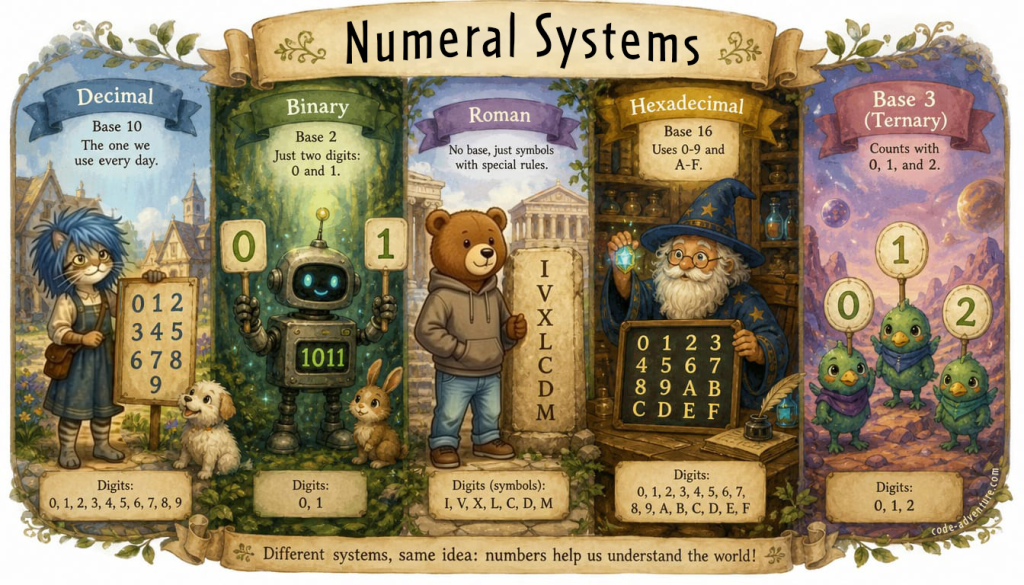
Numeral systems (number systems) represent values and quantities using a defined set of symbols and rules for representing and manipulating numbers. Throughout history, different cultures have developed and used many of these systems.
Understanding numeral systems such as binary, decimal, octal, and hexadecimal is essential in computer science because computers represent and process information using these systems.
For example, all data – including videos, music, and games – are ultimately represented by a sequence of binary digits.
- Data: Computers store and process all data using binary (including text, images, audio, and videos).
- Hexadecimal color values: Colors can be specified with hexadecimal values (such as #FF33EE).
- Memory addresses: Computers use numerical addresses to identify locations in memory. These addresses are represented as binary values internally, but they are often displayed in hexadecimal because hexadecimal is more compact and easier for humans to read.
- Network communication: Binary (base-2) is used because computer systems represent IP addresses as 0s and 1s. IPv4 addresses are stored as binary values but are commonly displayed as four decimal numbers separated by dots (for example, 192.168.1.1). Hexadecimal (base-16) is also commonly used in networking for MAC addresses and IPv6.
Common Numeral Systems
Key Insight
Numeral systems represent values and quantities using a specific set of symbols, and their own framework for how numbers are counted, combined, and calculated.
Examples:
- Binary (Base-2): Uses only two symbols, 0 and 1
- Decimal (Base-10): Uses the numbers 0 to 9
Every day, people use the decimal numeral system to count, measure, and perform calculations. Computers, however, rely primarily on the binary numeral system, while programmers frequently work with hexadecimal and, occasionally, octal. Understanding how these numeral systems work is a fundamental skill in computer science because they form the basis of data representation, memory organization, and digital communication. Whether interpreting hexadecimal color codes, reading memory addresses, or analyzing network data, numeral systems appear throughout computing.
Common systems programmers, software engineers, and computer scientists use:
- Binary (base-2): 2 digits (0 and 1)
- Octal (base-8): 8 digits (0-7)
- Decimal (base-10):
- Hexadecimal (base-16): 16 digits (0–9 and A-F)
Binary (Base-2)
Every piece of data stored on a computer is ultimately represented as a sequence of binary digits, or bits. Binary is a base-2 number system that uses only two symbols: 0 and 1. These values correspond to the two possible states used by digital electronic circuits, such as off and on (or low and high voltage).

Decimal (Base-10)
The decimal (base-10) numeral system is the standard system used for counting and arithmetic in everyday life. It uses ten digits (0 through 9) and each digit’s position represents a power of 10.

Octal (Base-8)
Octal (base-8) is a number system that uses eight digits: 0 through 7. Each place value represents a power of 8, just as decimal (base-10) uses powers of 10. For example, the octal number 17 equals 15 in decimal because 1×8+7=15.
Programmers often learn octal because it provides a compact way to represent binary data. Since one octal digit corresponds to exactly three binary bits, binary numbers can be grouped into sets of three and converted to octal quickly.
Hexadecimal (base-16) is more common, but octal is still used in some areas of computing, especially Unix/Linux file permissions (such as 755 or 644) and in certain legacy systems and programming languages. Understanding octal helps programmers read these values correctly and deepens their understanding of how computers represent and manipulate data.

Hexadecimal (Base-16)
The hexadecimal (base-16) numeral system uses both digits and letters; the digits 0–9 represent values 0 to 9, and then letters A–F represent values from 10 to 15. It is a shorter and more readable representation of long binary numbers, making it useful for programming, memory addressing, and debugging.
Programmers learn hexadecimal because it provides a compact, human-readable way to represent binary data. Each hexadecimal digit corresponds to exactly four binary bits, making it easy to convert between binary and hexadecimal.
Hexadecimal is widely used in programming for representing memory addresses, machine code, color values in web design (such as #FF6633), and debugging low-level software. Understanding hexadecimal helps programmers read and interpret computer data more efficiently and strengthens their understanding of how computers store and process information.

Bases in Numeral Systems
The base (or radix) of a numeral system tells us how many symbols are available before we move to the next place value (positional place).
Base definition: The number of unique symbols available in a numeral system. Each place value represents a power of the base.
Power of the base examples:
- Binary place values are powers of 2: 1, 2, 4, 8, 16, …
- Decimal place values are powers of 10: 1, 10, 100, 1000, …
Base Notation Examples:
- Binary: 1010₂
- Octal: 12₈
- Decimal: 10₁₀
- Hexadecimal: A₁₆

Positional Systems (Place Value)
The binary, octal, decimal, and hexadecimal numeral systems are positional numeral systems. In a positional system, the value of a digit depends on both the digit itself and its position within the number. For example, in the decimal (base-10) system, each digit represents a power of 10.
Therefore, the number 465 is not equal to 564 because the digits occupy different positions and have different place values.
In decimal the number 465 means:
- 4 hundreds
- 6 tens
- 5 ones
Each position represents a power of the system’s base.
For example, in the decimal (base-10) system, the number 465 can be written as:
465 = (4 × 10²) + (6 × 10¹) + (5 × 10⁰)
Since the digits in 564 occupy different positions, its value is:
564 = (5 × 10²) + (6 × 10¹) + (4 × 10⁰)
Even though both numbers contain the same digits, their values are different because the positions of the digits are different.
However, not all numeral systems are positional. In the Roman numeral system, symbols have fixed values and are combined according to addition and subtraction rules rather than place value.
Numeral Systems Comparison
Example numbers in binary, octal, decimal, and hexadecimal:
| Binary | Octal | Decimal | Hexadecimal |
|---|---|---|---|
| 0000 | 0 | 0 | 0 |
| 0101 | 5 | 5 | 5 |
| 1000 | 10 | 8 | 8 |
| 1010 | 12 | 10 | A |
| 1101 | 15 | 13 | D |
| 1111 | 17 | 15 | F |
| 10000 | 20 | 16 | 10 |
Summary
Numeral systems are a fundamental concept in computing and digital technology; mastering them helps with understanding how computers store, process, and transmit information.
Expand Your Knowledge
Explore binary and hexadecimal systems in more detail in the articles linked below – including how computers use binary to store information, and why hexadecimal is useful for representing colors, memory addresses, and other data.
- Binary Numeral System (Base-2)
- Decimal Numeral System (Base-10)
- Hexadecimal Numeral System (Base-16)
- Bits and Binary: The Language of Computers
- Decimal and Binary: Numeral System Conversions