
Binary is often described as the language computers use to represent information at the hardware level. Simply put, it uses two values (0 and 1) to represent information.
Computers work with electrical signals, and digital hardware is designed to distinguish between two reliable signal states. We represent those states as 0 and 1. This gives computers a simple way to represent and process numbers, text, images, audio, video, and software.
Understanding binary is useful for programmers because it helps explain how computers represent data, use memory, and work with different data types.

What is Base-2?
Binary is a base-2 numeral system, meaning it uses only two digits: 0 and 1.
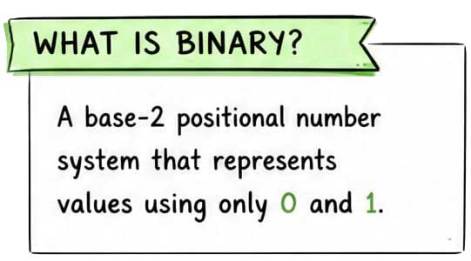
Our everyday number system, decimal, is base-10 because it uses ten digits (0–9). Hexadecimal is base-16 because it uses sixteen symbols (0–9 and A–F). Binary is base-2 because it has only two possible digits.
Each position in a binary number represents a power of 2, just as each position in a decimal number represents a power of 10.
A single binary digit is called a bit (a portmanteau of “binary digit”).
With 8 bits, there are: 2⁸ = 256 possible combinations. For an unsigned 8-bit value, those combinations represent the numbers 0 through 255.
Why Only Two Values?
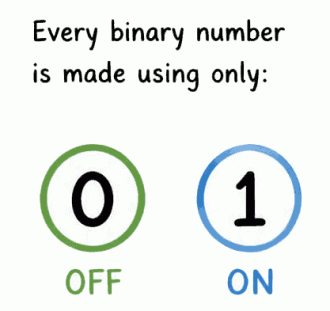
Digital computers are built from electronic circuits that are designed to reliably distinguish between two ranges of electrical signals. We label these states as 0 and 1.
You can think of this as a very simple decision:
- 0 = one signal state
- 1 = another signal state
The actual electronics are more complicated than a simple “on/off” switch, but the two-state model makes it easier for digital hardware to reliably represent and process information. This is one reason binary is so important to computing: electronic circuits can be designed to work reliably with two distinct states.
What Can Binary Represent?
Binary itself doesn’t determine what a collection of bits means. The same bits can represent different kinds of information depending on how a computer interprets them. In other words, bits are the building blocks; the interpretation gives those bits meaning.
For example, bits can represent:
- Numbers
- Text
- Images
- Audio
- Video
- Instructions for a processor
- Data used by games and applications
Why Should Programmers Care About Binary?
You probably won’t spend much time writing long strings of 0s and 1s by hand. However, understanding binary helps explain several important programming concepts.
Key Insights
- Binary is base-2: It uses only the digits 0 and 1.
- A bit is one binary digit: A bit can have one of two values, 0 or 1.
- Each position represents a power of 2: This is what makes binary a positional number system.
- More bits mean more possible combinations: With n bits, there are 2ⁿ possible combinations.
- Bits can represent many kinds of data: The meaning depends on how the computer interprets the bits.
- Data types have limits: A fixed number of bits can represent only a finite range of values.
- Memory and data representation: Bits and bytes help explain how computers store values and how much memory different data types require.
- Data limits: The number of bits available determines how many different values can be represented. This helps explain concepts such as integer ranges and overflow.
- Lower-level debugging: When working with systems programming, game development, networking, or security, you may encounter binary data or hexadecimal representations of memory and data.
- Bitwise operations: Programming languages provide operations that work directly with individual bits. These are useful in areas such as embedded systems, graphics, networking, permissions, and performance-sensitive code.
- Understanding computers: Binary provides a foundation for understanding how higher-level programming concepts eventually connect to hardware.
Summary
Binary is a base-2 number system that uses only 0 and 1. A single binary digit is called a bit, and groups of bits can be used to represent numbers and many other kinds of information.
Computers use digital electronic circuits that are designed to distinguish between two signal states, which we represent as 0 and 1. By combining many bits and interpreting them according to specific rules, computers can represent everything from numbers and text to images, audio, video, and program instructions.
You don’t need to memorize long strings of binary to be a good programmer. But understanding basic ideas such as bits, bytes, powers of 2, representation, and data limits, gives you a better understanding of what your code is doing underneath the abstractions.
Expand Your Knowledge
- Decimal Numeral System (Base-10)
- Hexadecimal Numeral System (Base-16)
- Numeral Systems and Data Representation
- Bits and Binary: The Language of Computers
- Decimal and Binary: Numeral System Conversions
- Evolution of Programmability: Encode, Automate, Transform
- Binary Numbers: AP Computer Science Principles Review

